
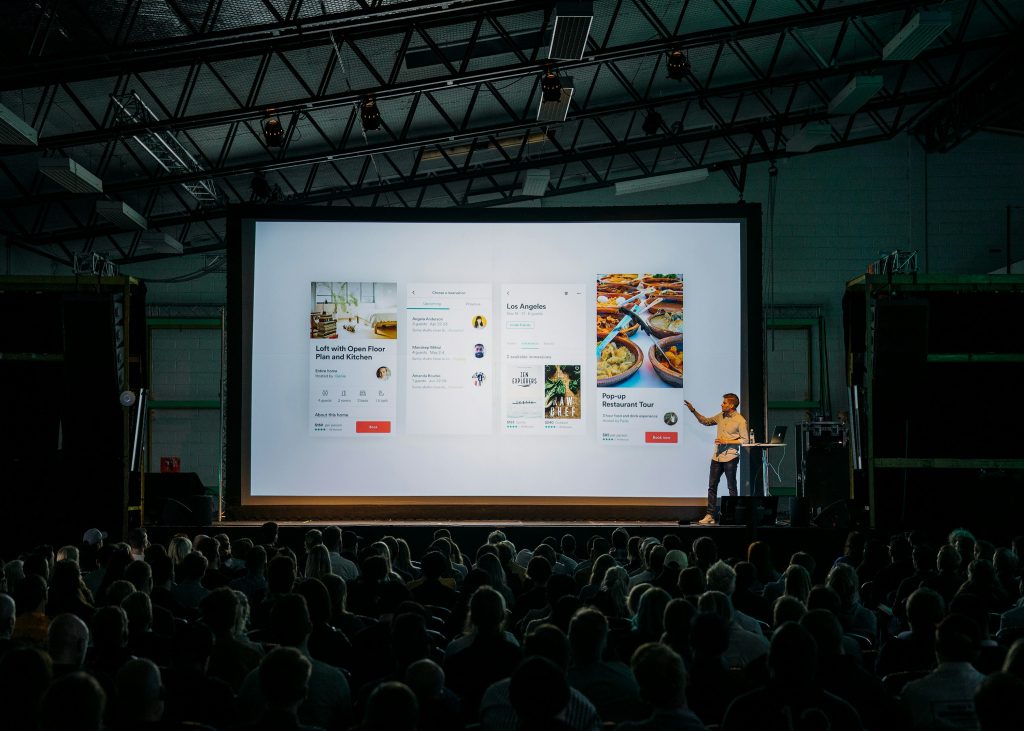

How you start your presentation decides what happens next.
First impressions form in milliseconds and are hard to change. Your audience judges your competence and credibility before you finish your first paragraph.
Here’s what happens neurologically when you open a presentation:
The audience’s attention opens or shuts. A strong opening engages them; a weak one loses them to their phones.
In 30 seconds, your audience decides if your presentation will be useful, boring, or a waste of time. These early guesses often come true because people look for what they expect.
Social proof kicks in. In groups, people watch each other for cues. If you start strong and grab attention, others will join in. If you stumble, doubt spreads quickly.
The executives I work with at Morgan Stanley, HSBC, BNP Paribas, and Mastercard all say the same thing: they know within 30 seconds if a presentation will be good. Learning to open well isn’t optional. It’s what separates being heard from being ignored.
The 5 Fatal Mistakes When Opening a Presentation
Before I show you what works, let’s eliminate what doesn’t. These opening mistakes kill presentations:
Mistake 1: The Autobiographical Opening
“Good morning, my name is Sarah, I’m the Director of Marketing, and I’ve been with the company for seven years…”
Unless you’re speaking to strangers, your audience already knows who you are—or doesn’t care yet. Credentials only matter after you’ve shown value. Starting with your bio is like describing the chef’s resume before tasting the food.
Mistake 2: The Agenda Recitation
“Today I’m going to cover four main areas: first, the market analysis; second, our competitive position; third, the proposed strategy; and fourth, the implementation timeline…”
Agendas are helpful, just not as openers. They tell people what’s coming, but not why it matters. It’s like a trailer that only lists scenes.
Mistake 3: The Apology Opening
“I know you’re all busy, so I’ll try to keep this brief…” or “I’m not really an expert on this, but…” or “Sorry, I’m a bit nervous…”
Starting with an apology weakens your authority. It shows you don’t believe your message is worth their time. Don’t apologize for presenting.
Mistake 4: The Technical Difficulties Opening
“Can everyone see this, okay? Let me just… hold on… is this working? Sorry, technical issues…”
Check your technology before you start. Tech issues at the start show you weren’t prepared and make things harder.
Mistake 5: The Housekeeping Opening
“Before we begin, just a few housekeeping items — toilets are down the hall, fire exits are here and here, please silence your phones…”
Housekeeping can be put off, handled by someone else, or skipped. Don’t waste your opening moments on logistics.
All these mistakes have the same problem: they focus on you, not your audience. A strong opening answers one question right away: why should I listen?
How to Open a Presentation: The 30-Second Framework
After analyzing thousands of presentations — both successful and unsuccessful — I’ve found a framework that works every time. Here’s how to open a presentation in 30 seconds: with a surprising statement, question, statistic, or story opening. This is your “pattern interrupt” — something that breaks through the noise and signals “this is different.”
Second 10–20: The Relevance Bridge
Link your hook to something your audience cares about. Why does it matter to them? What’s at stake? This turns curiosity into real interest.
Second 20–30: The Promise
Tell them what they’ll gain by listening. What will they learn, be able to do, or decide by the end? This keeps things moving forward. You will see this framework in action with 20 specific techniques.
How to Open a Presentation: 20 Proven Techniques
Here are 20 ways to open a presentation that commands attention. Each one follows the 30-second framework and can be adapted to any context.
Category 1: Question Openings
Questions get your audience thinking. They can’t help but start coming up with answers, which means they’re engaged.
Technique 1: The Pain Point Question
“How many hours did your team spend on presentations last month? For most companies I work with, the answer is shocking — and most of that time is wasted. Today I’m going to show you how to cut that number by 70%.”
Technique 2: The Thought-Provoking Question
“What would you do with an extra £2 million in your budget? That’s not hypothetical — it’s what’s at stake in the decision we’re making today.”
Technique 3: The Show of Hands Question
“By show of hands, how many of you have sat through a presentation this month that should have been an email? [Wait for hands] Keep your hand up if you’ve given one. [Pause] Today we’re fixing that.”
Technique 4: The Rhetorical Challenge
“What if everything you believe about [topic] is holding you back? In the next 15 minutes, I’m going to challenge three assumptions that are costing this company money.”
Category 2: Story Openings
Stories have a strong effect on the brain. They release oxytocin, activate different brain areas, and are remembered much more than facts alone.
Technique 5: The Personal Failure Story
“Three years ago, I nearly lost our biggest client. Not because of bad work — because of a presentation I thought was good but wasn’t. What I learned from that failure is why we’re here today.”
Technique 6: The Client Success Story
“Last month, a client called me in a panic. Board presentation in four hours, zero slides ready. By the time she walked into that boardroom, she had 12 polished slides and the confidence to deliver them. The board approved her £5 million proposal. Here’s the method she used.”
Technique 7: The “I Was There” Story
“I was sitting in the boardroom at [Company] when the CEO said something that changed how I think about [topic]. She said: ‘[Quote].’ Today I’m going to show you how to apply that insight.”
Technique 8: The Contrast Story
“Two teams. Same data. Same deadline. Same stakeholders. One got their proposal approved in the first meeting. The other is still waiting after six months. The difference? How they opened their presentation.”
📋 Want 50+ Opening Scripts Ready to Use?
The Presentation Openers & Closers Swipe File (£9.99) includes 50+ tested scripts for opening strong and closing memorably — organized by presentation type with fill-in-the-blank templates.
Category 3: Data Openings
The right statistic stops people in their tracks. It should be surprising, relevant, and instantly clear. 2.3 million—that’s what this problem cost us last year. Today, I’ll show you how to cut that in half with an investment of £150,000.
Technique 10: The Comparison Statistic
“Our competitors close deals in 45 days. We take 78. That 33-day gap is costing us £4 million in lost revenue each year. This presentation is about closing that gap.”
Technique 11: The Time-Based Statistic
“In the time it takes to give this presentation — 15 minutes — we’ll lose £12,000 to [problem]. By the end, you’ll know how to stop that leak.”
Technique 12: The Personal Statistic
“I’ve given over 500 presentations in my career. Exactly 3 of them changed my life. Today I’m going to show you what made those 3 different — and how to apply it to your next presentation.”
Category 4: Bold Statement Openings
Bold statements show confidence and spark interest right away. They work best when you can support them.
Technique 13: The Contrarian Statement
“Everything you’ve been told about [topic] is wrong. The conventional wisdom is costing companies millions — and I have the data to prove it.”
Technique 14: The Prediction Statement
“By 2027, half the companies in this industry will be gone. The ones that survive will have done one thing differently. That’s what we’re here to discuss.”
Technique 15: The Promise Statement
“In the next 15 minutes, I’m going to give you a framework that will cut your presentation prep time from 6 hours to 90 minutes. And I’ll prove it works before you leave this room.”
Technique 16: The Challenge Statement
“I’m going to challenge you to think differently about [topic]. Some of you will resist. By the end, I think you’ll agree the change is worth it.”
Category 5: Situational Openings
These openings recognize the situation and make your message instantly relevant. Technique 17: The Current Event Opening
“You’ve seen the news this morning about [relevant event]. What you might not realize is how directly it affects the decisions we’re making today. Let me show you the connection.”
Technique 18: The Callback Opening
“In our last meeting, someone asked a question I couldn’t fully answer. I’ve spent the past two weeks finding that answer — and it led me somewhere unexpected.”
Technique 19: The Elephant in the Room Opening
“I know what you’re thinking: not another presentation about [topic]. I thought the same thing before I saw these numbers. Give me 10 minutes to change your mind.”
Technique 20: The Direct Address Opening
“You asked for a recommendation on [topic]. My recommendation is [answer]. The rest of this presentation is the evidence. If you’re convinced after 10 minutes, we can stop early.”
How to Open a Presentation: Matching Technique to Context
Not every opening works for every situation. Here’s how to choose:
For Board Presentations
Best techniques: Direct Address (#20), Shocking Statistic (#9), Promise Statement (#15)
Board members are time-poor and decision-focused. Open with your recommendation or the key number, then support it. Don’t make them wait.
For Sales Pitches
Best techniques: Pain Point Question (#1), Client Success Story (#6), Comparison Statistic (#10)
Sales openings should connect to the prospect’s world immediately. Lead with their problem or a result someone like them achieved.
For Team Meetings
Best techniques: Show of Hands (#3), Personal Failure Story (#5), Contrast Story (#8)
Teams respond to connection and authenticity. Stories and interactive elements build engagement.
For Conference Talks
Best techniques: Contrarian Statement (#13), Personal Statistic (#12), Thought-Provoking Question (#2)
Conference audiences have chosen to be there but are easily distracted. Open with something memorable and different.
For Investor Pitches
Best techniques: Time-Based Statistic (#11), Prediction Statement (#14), “I Was There” Story (#7)
Investors want to see pattern recognition and urgency. Show you understand where the market is going and why now matters.
How to Open a Presentation: The First Slide Question
Your opening isn’t just what you say — it’s what you show. Here’s how to handle your first slide:
Rule 1: Your first slide should support your opening, not replace it.
If you’re opening with a statistic, your first slide might display that number in large text. If you’re opening with a question, your first slide might display it. If you’re opening with a story, your first slide might be a simple image that sets the scene.
Rule 2: Avoid the title card trap.
The standard “Title / Your Name / Date / Company Logo” slide is wasted space. It tells your audience nothing and creates no engagement. Skip it or replace it with something that hooks.
Rule 3: Consider starting with a black screen.
For high-stakes presentations, try opening without a slide. Just you, speaking directly to the room. Advance to your first visual only after you’ve delivered your hook. This creates presence and signals confidence.
For more on this, see: The First 30 Seconds: Why Most Presenters Lose Their Audience Immediately.
How to Open a Presentation: Practice Protocol
Knowing how to open a presentation isn’t enough — you need to execute it smoothly. Here’s my practice protocol:
Step 1: Write your opening word-for-word.
Don’t wing the most important 30 seconds of your presentation. Script it precisely.
Step 2: Time it.
Your opening should be 30–45 seconds maximum. If it’s longer, cut it.
Step 3: Memorize it.
Your opening is the one part of your presentation you should know cold. You should be able to deliver it while walking into the room, without notes, without slides.
Step 4: Practice it out loud 10 times.
Not in your head — out loud. Record yourself. Listen back. Refine.
Step 5: Practice the transition.
The move from your opening to your first main point should be seamless. Practice this bridge until it’s automatic.
This protocol takes 30 minutes. It’s the highest-ROI time you can spend on any presentation.
How to Open a Presentation: Common Questions
How long should a presentation opening be?
30–45 seconds maximum. That’s roughly 75–100 words spoken at a natural pace. Your opening should hook attention, establish relevance, and create forward momentum — then get out of the way.
Should I introduce myself when opening a presentation?
Only if the audience genuinely doesn’t know who you are. Even then, keep it to one sentence after your hook, not before it. Establish value first, credentials second.
How do I open a presentation when I’m nervous?
Memorize your opening word-for-word. When you know your first 30 seconds cold, you can deliver them on autopilot while your nerves settle. Most presentation anxiety peaks in the first minute — a solid, memorized opening gets you through it.
What if my opening doesn’t land?
Keep going. Don’t acknowledge it, don’t apologize, don’t try a different opening. Commit to your approach and trust your content. One flat moment doesn’t define a presentation.
Can I use humor to open a presentation?
Only if you’re genuinely funny and the context supports it. Bad humor is worse than no humor. If you’re unsure, use a different technique. A compelling question or statistic is safer and often more effective than a joke.